

Enslave the oppressors
Automated behave + qecore-headless + dogtail and shared libraries for testing GNOME-based bootc images. Headless & Kubernetes-native.
We continuously test 323 active end-to-end BDD scenarios across 52 feature files against live Wayland desktop sessions in QEMU.
| Metric / Gating Dimension | Active Tests | Coverage & Validation Scope |
|---|---|---|
| Core Desktop UI & Shell | 35 scenarios | GNOME Shell Top Bar, Quick Settings panel, Calendar popup, Workspace Switcher, Lock Screen safety, and System menus. |
| Preinstalled Graphical Apps | 107 scenarios | Core GUI application verification including Nautilus (Files), Firefox Browser, Loupe Image Viewer, Papers Document Viewer, Text Editor, and Calculator. |
| Desktop & Portals | 18 scenarios | Complete XDG Desktop Portals validation: Dark/Light Mode settings, User Screenshots, FileChoosers, desktop notifications, and Sandboxed Flatpak bridges. |
| Modern Linux Principles | 104 scenarios | Secure Boot image signing policy verification (cosign), custom Polkit privilege-escalation rules, read-only /usr, user environment initialization, and dconf system defaults. |
| Upgrades & Multi-Variant Parity | 57 scenarios | Robust Aurora, Bazzite, GNOME OS, Fedora, Flatcar and Universal Blue base image stream parity checks, plus parameterized bootc container upgrades and multi-lane migrations. |
Want to test anything? Tests are easy to write
- GNOME 50+
- Agent-first: autonomous AI agents are primary contributors to GNOME 50 port - based off of Red Hat's enterprise GNOME 47 suite
- The more tests we publish the more we prove that we can put the clankers to work for us and get better linux desktops
- Image-specific suites: Yes, we can add your custom image
- Or run your entire setup by using these as github actions!
- Any GNOME-based bootc image can use the
commonandsmokesuites as a portable health gate - KDE (Help! Expertise needed!)
- Designed for Kubernetes
- projectbluefin/testing-lab (Here's how we do it!)
- one ujust command - the entire enchilada - remember kids, cloud native implies local first development! (What?!)
Below is the live framebuffer captured automatically during our last successful end-to-end Wayland smoke-test run:
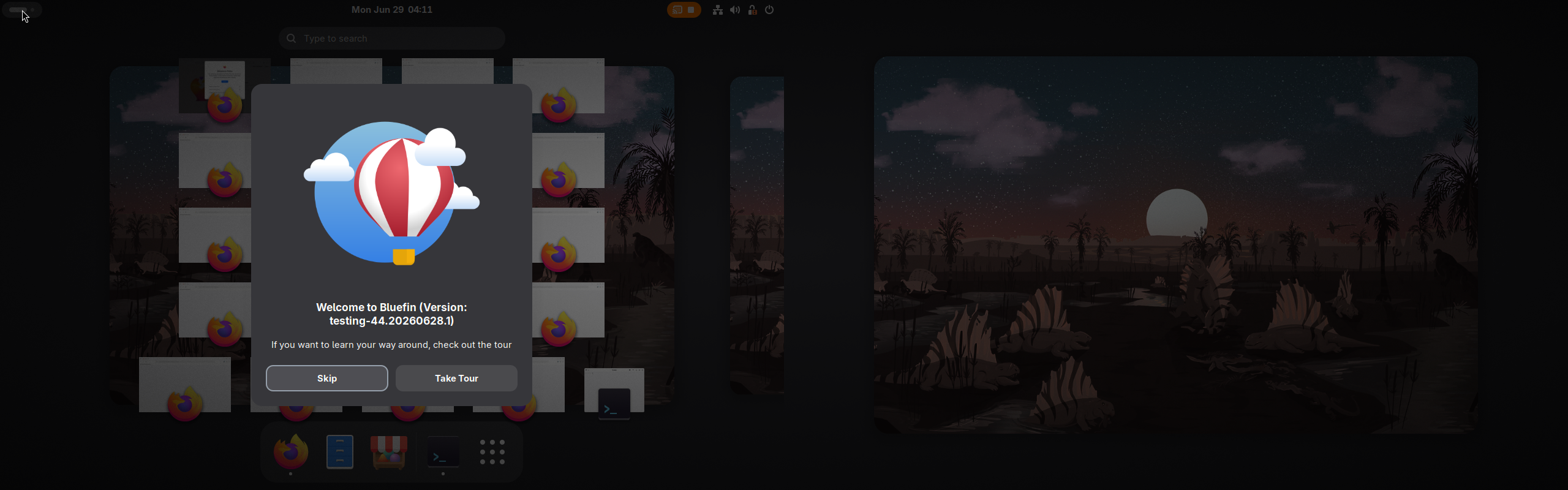
Click the screenshot to open our interactive Live Build Health Dashboard & Gallery.
projectbluefin/bluefin   ──┐
projectbluefin/bluefin-lts ┼──▶ images ──▶ testsuite (e2e gate) ──▶ promotion
projectbluefin/dakota    ──┘

Any GNOME bootc image ──────────────────▶ testsuite (smoke + common)
| Concern | Canonical repo |
|---|---|
| Infrastructure (ArgoCD, KubeVirt, manifests, CronWorkflows) | projectbluefin/testing-lab |
| Test framework and suite content (feature files, steps, qecore/dogtail patterns) | projectbluefin/testsuite |
| Layer | Tool | Purpose |
|---|---|---|
| BDD runner | behave | Gherkin scenarios and step binding |
| Session bridge | qecore-headless | Wayland/DBus session bootstrap |
| GUI automation | dogtail (AT-SPI) | Accessibility-tree interactions |
| Wayland bridge | gnome-ponytail-daemon | Coordinate injection support |
| Shell bridge | org.gnome.Shell.Eval |
GNOME 50+ top-bar fallback path |
| SSH bridge | shared SSH steps | Out-of-VM system health assertions |
Core GNOME functionality verified visually against a live Wayland session:
- GNOME Shell, Settings panels, Notifications, Calculator, Text Editor, Files (Nautilus)
- Firefox launch via Flatpak
- MIME handler registration — HTML → Firefox, PDF → Papers, PNG → Loupe, video → Totem
- GNOME Accessibility infrastructure (AT-SPI daemon, high-contrast toggle, a11y Settings panel)
- Bluefin desktop identity — Wayland session, hardware acceleration, Dash to Dock, system tray
- GNOME extensions presence
Portable health checks suitable for any GNOME bootc image:
- Flatpak model: Flathub-only remote, no Fedora remote, required system apps present
- Flatpak state: correct remote configuration after first boot
- XDG portal health:
xdg-desktop-portal,xdg-desktop-portal-gnomeactive; D-Bus interface reachable - XDG portal integration: FileChooser, Screenshot, OpenURI, Notification interfaces introspectable
- Container runtime: podman available, storage driver set, rootless socket active, can run a container
- Polkit rules: custom rules present and parseable, daemon running, no syntax errors
- Shell environment:
/etc/environmentpresent, modern CLI tools (zsh, fish, fzf, bat, eza, starship) - Shell sourcing: shell rc files source cleanly without errors
- System scripts:
ujust,ublue-image-info,ublue-system-setup,ublue-user-setup,bootc - ujust recipes: non-destructive recipe smoke tests (check-local-overrides, logs-this-boot, bios-info, changelogs)
- GSettings/dconf defaults: custom-command-list extension in defaults, locked keys enforced, keybindings configured
- Immutable OS integrity: no layered RPMs,
/usrmounted read-only, bootc status reports a pinned image - Desktop entries: no graphical RPM apps pointing to
/usr/bin(Flatpak-only model) - Signing and security: image signing policy assertions
- hardware: udev rules syntax validation, emulated peripherals
- software: Bazaar app store launch, search, config YAML integrity, Flatpak CLI health
- developer: Homebrew/Ptyxis on Bluefin developer variant
- dx: VS Code, distrobox, JupyterLab, mise on DX variant
- lifecycle: bootc upgrade / rollback / migration
- security: cosign signature verification
- vanilla-gnome: upstream GNOME OS baseline (comparison against Bluefin smoke)
- bazzite: Bazzite-specific extensions and shell behavior
- flatcar: Flatcar OS boot and lifecycle
just lint        # validate Argo manifests
just list-stubs  # inspect not-yet-implemented scenarios
Authoring rules, patterns, and skill docs → docs/skills/
Start with docs/skills/index.md.
This repo is agent-first: AI agents are the primary authors of GNOME 50 test coverage. Every agent session produces two outputs — the work (PR) and the learning (skill doc update). The skill docs in docs/skills/ are the institutional memory that makes each agent session start smarter than the last.
Agents can file issues and submit PRs directly without human gating (within the gates defined in docs/skills/human-gates.md). The @future tag marks scenarios awaiting implementation — run just list-stubs to see the current list. The docs/skills/ tree routes each task type to the right patterns and avoids re-discovering the same gotchas.
- CI uses Python 3.14 (
actions/setup-pythonin.github/workflows/pr-validate.ymland.github/workflows/unit-tests.yml), so use Python 3.14 locally as well. - Install the local Python pieces with
pip install behave qecore dogtail(qecore-headlessis the runner binary installed by theqecorepackage, not a separate pip package). gnome-ponytail-daemonis not a local pip install; it must already be baked into the image under test.- Full end-to-end runs still require a live Wayland + AT-SPI session, so they are not feasible for most contributors on a normal workstation. For most changes, the recommended execution path is the GitHub Action workflow below.
Any GNOME-based OS built as a bootc/ostree image can run this test suite as a PR gate on standard ubuntu-latest runners — no self-hosted hardware, no Argo, no ghost required.
If you are building a GNOME-based bootc image and want to add automated testing, the common and smoke suites are designed to work against any GNOME bootc image. The common suite runs entirely over SSH and validates system invariants that any well-formed immutable GNOME image should satisfy:
- Flathub is the only Flatpak remote
- XDG portals are healthy
- Container runtime is functional (podman)
- Polkit rules are present and parseable
- The OS is truly immutable (no layered RPMs,
/usrread-only) - Standard system scripts are present and executable
- bootc reports a pinned image
The smoke suite runs GUI automation over a live Wayland session and validates core GNOME functionality. Both suites are safe to run against any GNOME bootc image without Bluefin-specific knowledge.
Minimum image requirements:
bootc install to-diskcompatible OCI imagegnome-ponytail-daemonbaked in (for smoke suite; Wayland coordinate bridge)- GNOME 40+ with GDM autologin support
Add to your repo's .github/workflows/e2e.yml:
name: E2E Tests
on:
  pull_request:

jobs:
  test:
    uses: projectbluefin/testsuite/.github/workflows/e2e.yml@v1
    with:
      image: ghcr.io/myorg/myimage:latest   # your bootc OCI image
      suites: smoke,common                   # smoke | common | developer | dx | software | vanilla-gnome
Pin to @v1 — testsuite auto-updates the v1 tag on every merge to main. Renovate does not need to manage this pin.
If you wrap the reusable workflow in a workflow_dispatch to test an unreleased testsuite branch, resolve test_ref in the wrapper (${{ github.event.inputs.test_ref || github.ref_name }}) and pass it through. Do not rely on github.ref_name inside e2e.yml; in workflow_call it resolves to main.
For full control over artifact naming, concurrency, or triggering:
jobs:
  e2e:
    runs-on: ubuntu-latest
    timeout-minutes: 90
    steps:
      - name: Run GNOME e2e
        id: test
        uses: projectbluefin/testsuite/.github/actions/gnome-e2e@v1
        with:
          image: ghcr.io/myorg/myimage:latest
          suite: smoke

      - name: Upload results
        if: always()
        uses: actions/upload-artifact@v4
        with:
          name: e2e-results-${{ github.run_id }}
          path: results/

      - name: Fail on test failures
        if: steps.test.outputs.behave-rc != '0'
run: exit 1suites: smoke and suites: common each automatically expand into two parallel jobs (smoke-a + smoke-b, common-a + common-b), cutting wall time roughly in half. New .feature files added to these suites are picked up automatically — no manual shard configuration needed.
- OCI image must be a bootc/ostree image (uses
bootc install to-disk) gnome-ponytail-daemonmust be baked into the image for smoke suite (Wayland coordinate bridge)- Supported suites via GHA:
smoke,common,developer,dx,software,vanilla-gnome,bazzite,lifecycle securityandhardware(SSH-only mode) are not yet in the GHA action
| Input | Default | Description |
|---|---|---|
image |
— | OCI image ref to test (required) |
suites |
smoke |
Comma-separated suite names |
test_ref |
main |
projectbluefin/testsuite git ref for test content |
skip_native_apps |
false |
Skip @native_app scenarios (apps not in all variants) |
screenshot_flatpaks |
"" |
Flatpak app IDs to launch-and-screenshot after the test run |
chunked_enabled |
false |
Enable @zstd_chunked lifecycle scenarios |
memory |
4096 |
VM RAM in MB |
cpus |
4 |
VM CPU count |
free-disk-space |
true |
Run disk cleanup before provisioning |
| Tag | Image |
|---|---|
latest |
ghcr.io/ublue-os/bluefin:latest |
lts |
ghcr.io/ublue-os/bluefin:lts |
gts and lts-hwe are invalid for Bluefin.
- CI uses Python 3.14 (
actions/setup-pythonin.github/workflows/pr-validate.ymland.github/workflows/unit-tests.yml), so use Python 3.14 locally as well. - Install the local Python pieces with
pip install behave qecore dogtail(qecore-headlessis the runner binary installed by theqecorepackage, not a separate pip package). gnome-ponytail-daemonis not a local pip install; it must already be baked into the image under test.- Full end-to-end runs still require a live Wayland + AT-SPI session, so they are not feasible for most contributors on a normal workstation. For most changes, the recommended execution path is the GitHub Action workflow above.