
GPU-accelerated statevector and shot-based simulation for pytket.






🚀 Features • 📊 Benchmarks • 📦 Installation • ⚡ Quick Start • 💻 Development • 📄 Citing
pytket-custatevec is a high-performance extension for pytket that allows quantum circuits to be simulated on NVIDIA GPUs.
It acts as an open-source bridge to the NVIDIA cuQuantum SDK, utilizing cuStateVec to optimize memory usage and gate execution speed for large circuit simulations.
- High Performance: Designed for rapid simulation of quantum circuits using parallel GPU architecture.
- Seamless Integration: Works as a standard
pytketBackend. - Optimized Memory: Manages GPU VRAM efficiently for complex simulations.
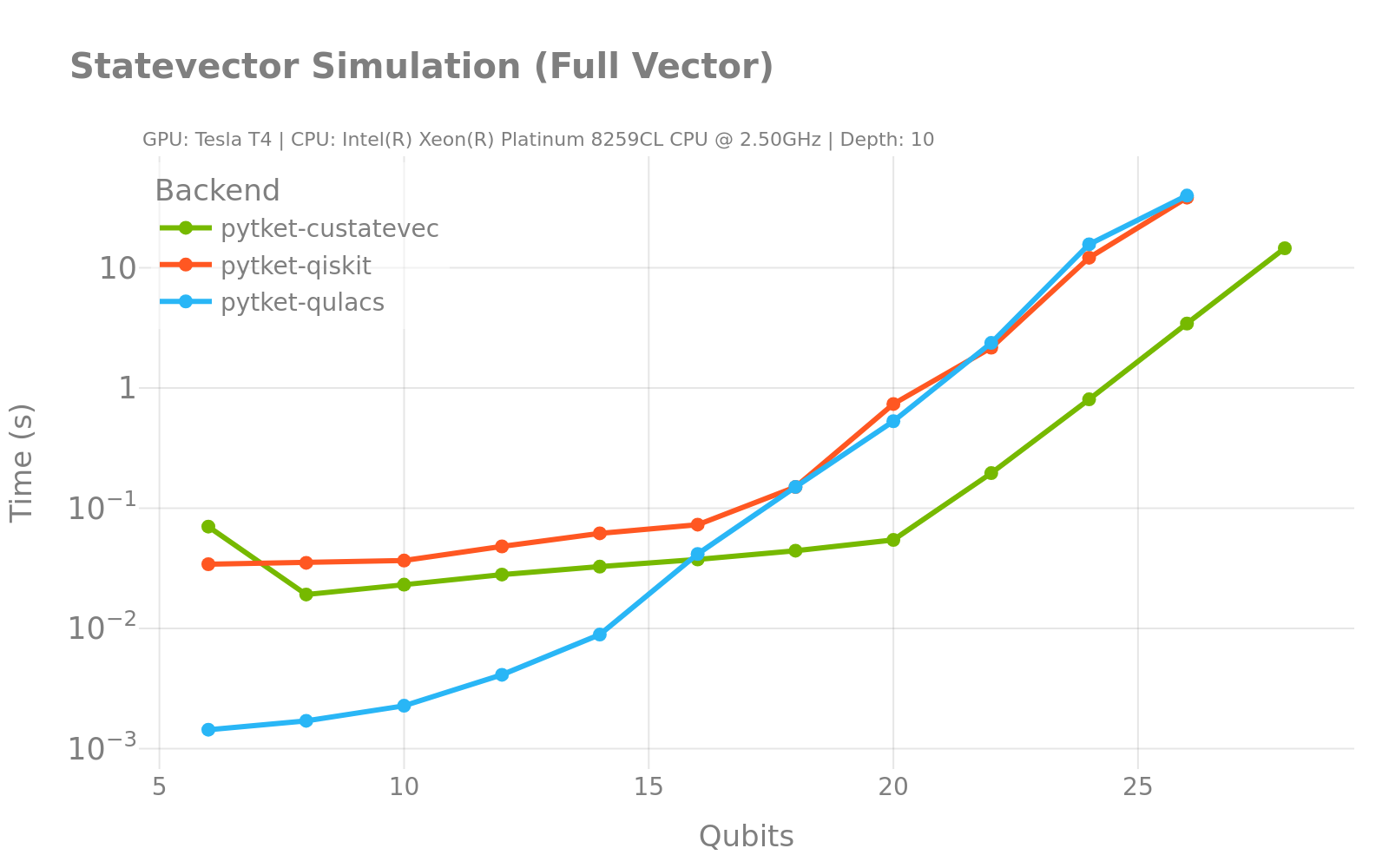
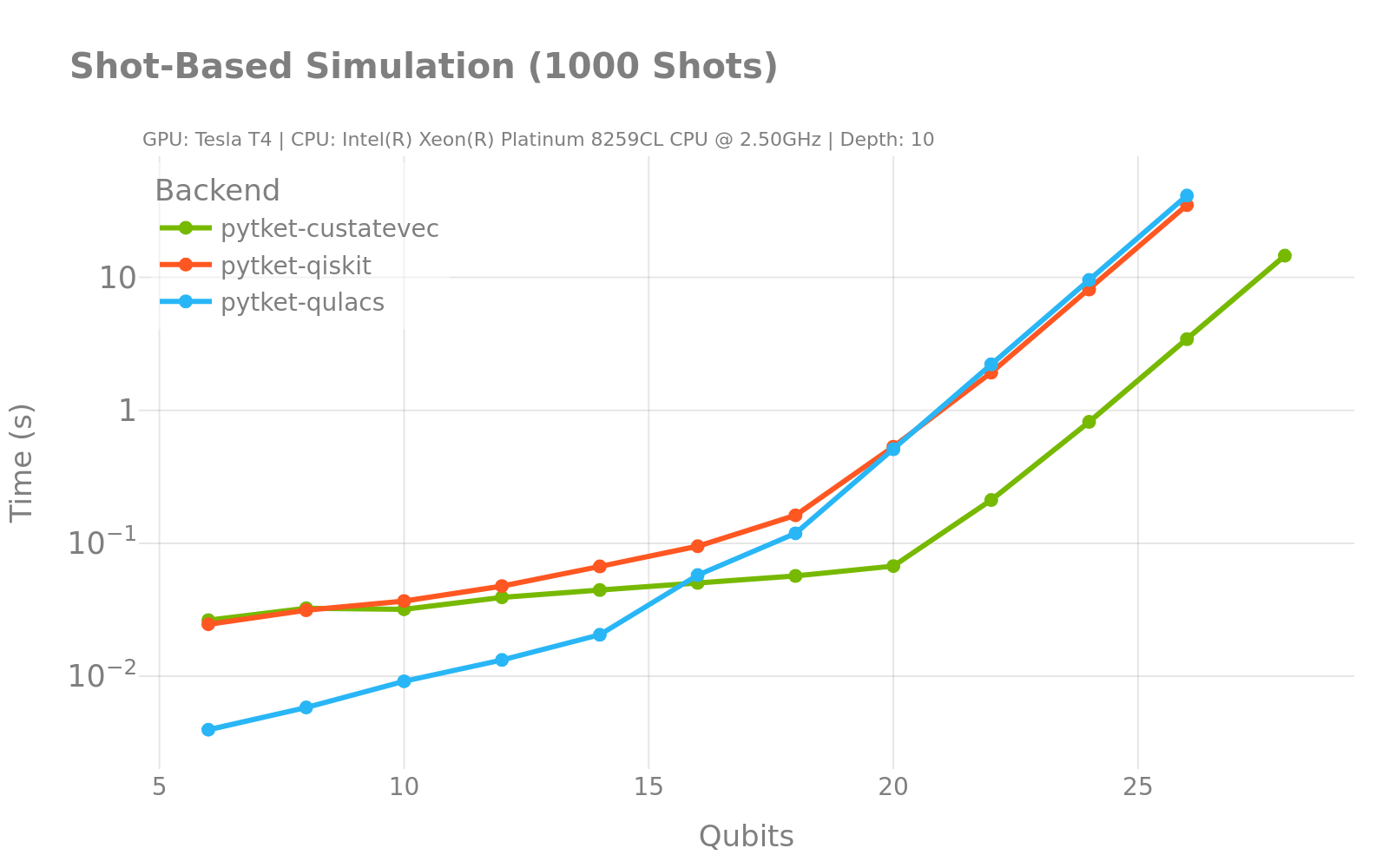
These results are auto-generated by our CI pipeline. They compare pytket-custatevec (GPU) against standard CPU simulators (Aer, Qulacs) for a dense random circuit.
Note
The charts above are static snapshots. View the Interactive Benchmarks in our documentation to see hardware details and zoom into specific data points.
Prerequisites
- Python 3.10+
- Linux machine with NVIDIA GPU (Compute Capability 7.0+)
- NVIDIA Drivers installed
Option A: Conda (Recommended) We recommend Conda to reliably handle system-level CUDA libraries.
conda install -c conda-forge cuquantum-python
pip install pytket-custatevec
Option B: Pip You can install everything via pip, which pulls the necessary binary wheels automatically.
pip install pytket-custatevecfrom pytket import Circuit
from pytket.extensions.custatevec import CuStateVecStateBackend
# 1. Define a circuit
circ = Circuit(2).H(0).CX(0, 1)
# 2. Initialize the GPU backend
backend = CuStateVecStateBackend()
compiled_circ = backend.get_compiled_circuit(circ)
# 3. Run on GPU
statevector = backend.run_circuit(compiled_circ).get_state()
print(statevector)To install the extension in editable mode for development:
pip install -e ".[dev,docs,test]"We use pre-commit to maintain code quality. Before committing, run:
pre-commit runThis handles formatting (ruff), type checking (mypy), and linting.
To run the test suite (requires a GPU environment):
pytest tests/If you use pytket-custatevec in your research, please cite it as follows:
@software{pytket_custatevec,
  author = {{The pytket-custatevec Developers}},
  title = {pytket-custatevec: GPU-accelerated pytket simulation},
  url = {https://github.com/quantinuum/pytket-custatevec},
  year = {2025}
}