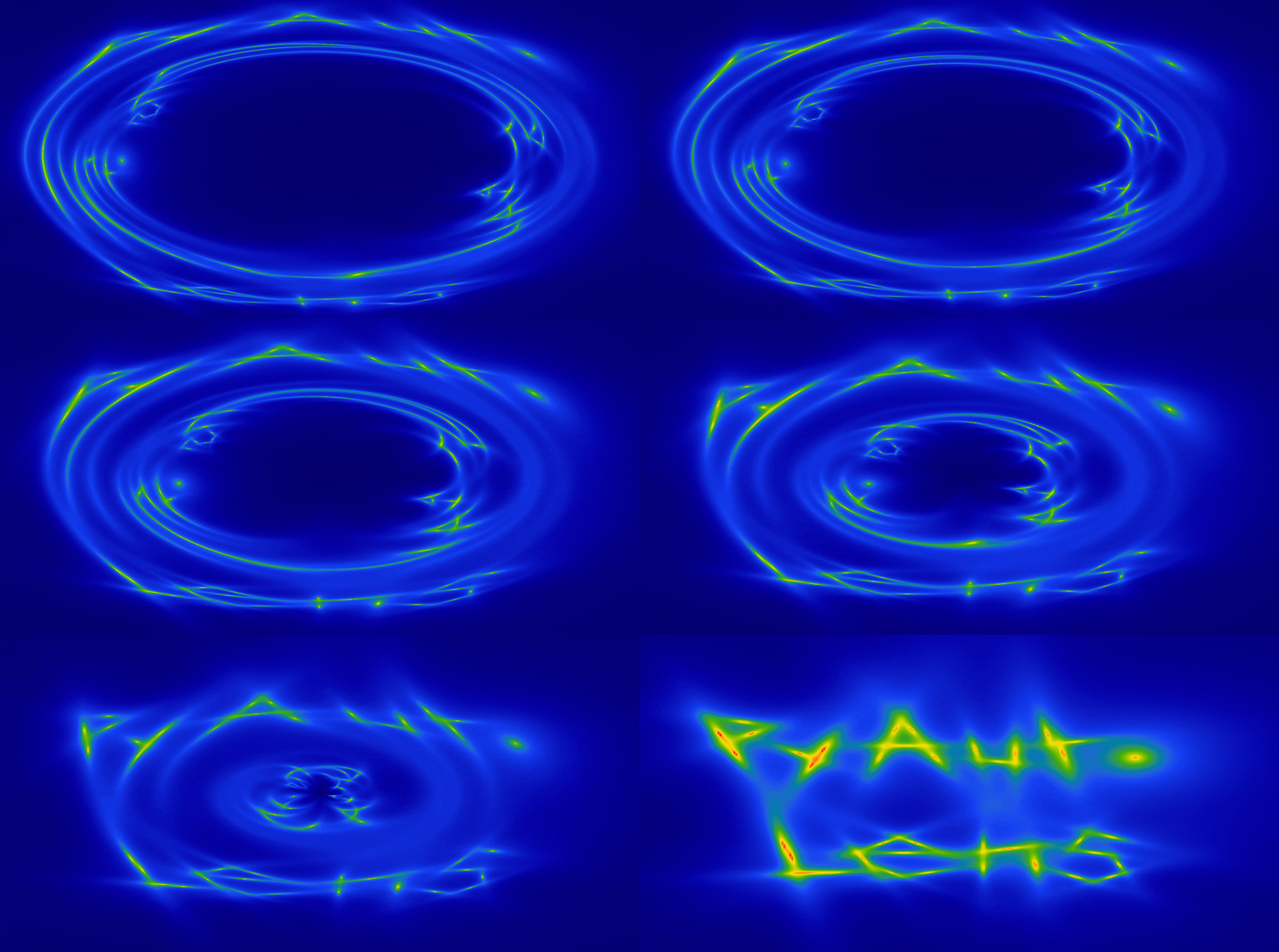
When two or more galaxies are aligned perfectly down our line-of-sight, the background galaxy appears multiple times. This is strong gravitational lensing, and PyAutoLens makes it simple to model strong gravitational lenses.
This repository is the PyAutoLens Assistant: an AI assistant which lets you use natural language to do gravitational lensing science.
First, choose how you want to use the assistant:
- Conversational AI assistant: Use a browser-based tool such as ChatGPT or Claude to ask questions, plan analyses, and generate scripts that you transfer to your computer and run manually.
- CLI coding agent: Use a terminal-based agent such as Claude Code or Codex. It can work directly on your computer to inspect
.fitsdata, write and execute scripts, diagnose errors, run lens models, and inspect their results.
A CLI coding agent provides the most complete autolens_assistant experience and is recommended, although a browser-based assistant may feel more familiar and allow you to get started more quickly.
Because AI tools change rapidly, consult Choosing Your AI Tool for the latest supported options, including both free and paid services.
To illustrate the autolens_assistant we will use James Webb Space Telescope imaging data of the
COSMOS-Web Ring, whose imaging
ships with this repository in dataset/imaging/cosmos_web_ring:

Take note of the lens galaxy, lensed source galaxy, extra galaxy and the 1.8" circular mask, your first
interactions with the autolens_assistant may ask you about how to handle these in your analysis!
As discussed in the guide, there are two ways to use autolens_assistant, choose
whichever best suits how you work with AI:
Depending on which assistant you chose in the guide, your first message may need to open with its setup instructions (for example the GitHub sync bootstrap prompt).
With that in place, here is a good initial prompt to try it out, noting that data for the COSMOS-Web Ring is included in this repository as an example:
[Setup instructions for your chosen assistant, if its guide page says you need them]

Find the data on the Cosmos-Web ring, give me a short script to plot it in PyAutoLens and then given that I'm a
new user give me an overview of the different ways we can perform strong lens modeling of this system.
The above prompt will give an overview of the PyAutoLens API for plotting, describe how you can perform lens modeling of the system, and ask you follow up questions which will get a discussion going so you can begin using PyAutoLens for a more specific task.
The autolens_assistant can easily handle more complex tasks: using the prompt below you'll get an end-to-end Python script for multi-wavelength lens modeling of the COSMOS-Web Ring!
[Setup instructions for your chosen assistant, if its guide page says you need them]

I want to model the F277W and F444W JWST imaging of the COSMOS-Web Ring independently, which are in
the folder dataset/imaging/cosmos_web_ring. Model the lens light with a multi-Gaussian expansion (MGE), its mass with a singular
isothermal ellipsoid plus external shear, and model the source also using an MGE. For speed, run the analysis on my
laptop GPU using a JAX optimizer that estimates only the maximum-likelihood solution. Plot the observed image at
each wavelength in the left column, its lensed source model in the middle column, and its source on the right column.
autolens_assistant has first-class support for AI coding agents such as Claude Code, Codex,
Antigravity and OpenCode. The setup guide covers each one, including which is
currently the best free option.
Once you have your coding agent setup, clone the autolens_assistant repo:
git clone https://github.com/PyAutoLabs/autolens_assistant.git
cd autolens_assistant
Next, open your AI coding agent in your terminal inside the autolens_assistant folder you just cloned.
If PyAutoLens is not already installed, the coding agent will use autolens_assistant to install it after you submit your first prompt.
Here is a good initial prompt to try it out, noting that data for the COSMOS-Web Ring is included in this repository as an example:
Find the data on the Cosmos-Web ring, give me a short script to plot it in PyAutoLens and then given that I'm a
new user give me an overview of the different ways we can perform strong lens modeling of this system.
If you want to see autolens_assistant perform end-to-end lens modeling:
I want to model the F277W and F444W JWST imaging of the COSMOS-Web Ring independently, which are in
the folder dataset/imaging/cosmos_web_ring. Model the lens light with a multi-Gaussian expansion (MGE), its mass with a singular
isothermal ellipsoid plus external shear, and model the source also using an MGE. For speed, run the analysis on my
laptop GPU using a JAX optimizer that estimates only the maximum-likelihood solution. Plot the observed image at
each wavelength in the left column, its lensed source model in the middle column, and its source on the right column.
The autolens_assistant adapts its behaviour to suit your prompt both when you are using a conversational assistant (e.g. ChatGPT)
or coding agent (e.g. Claude):
-
Want to plan your lens modelling analysis and compare the available approaches? Simply say so in your initial prompt.
-
Want the assistant to ask questions before performing a task, helping you understand the analysis and make informed choices? Ask it to guide you through the process.
-
Want it to complete a task end-to-end without consulting you? Tell it to one-shot the task.
If you are new to gravitational lensing, particularly an undergraduate or early-stage PhD student, ask the assistant to use Teacher Mode. It will explain the fundamentals of lensing and lens analysis in greater detail, while providing direct links to relevant, human-readable documentation so that you can understand what PyAutoLens is doing.
A good first session if you are new to PyAutoLens and want to learn the modelling workflow end-to-end using data you generate yourself. Starting with a simulation keeps things simple: the data are clean, the true model is known, and there are no observational complications, allowing you to focus on understanding each step.
Teacher mode.

I'm new to PyAutoLens and want to learn the basic workflow end-to-end. Can you
walk me through a simple example where we: 1) simulate Euclid-like imaging of
a simple strong lens; 2) make some plots of the lens and investigate its properties and;
3) fit the data and recover the lens model.
This example demonstrates how far the assistant can be pushed in performing a scientific analysis. The prompt aims to reproduce the famous dark matter subhalo detection in the strong lens SDSSJ0946+1006 and investigate evidence that its density profile is unusually concentrated. It does this through Bayesian model comparison.
The lens modelling required for this analysis may take hours or days. The final sentence asks the assistant to estimate the runtime and, if necessary, guide you through setting up and running the analysis on a High Performance Computing (HPC) system to which you have access.
Assistant mode.

The strong lens SDSSJ0946+1006 famously has a dark matter subhalo
detection that studies show is unusually concentrated. Analyse
the HST imaging of this lens provided at
dataset/imaging/slacs0946+1006/ and reproduce the detection.

Perform Bayesian model comparison to (a) confirm a subhalo is preferred
over a smooth-mass baseline which does not include a subhalos, and (b) test
the "super-concentrated" claim by comparing an SIS subhalo model
against a more shallow NFW mass profile at the recovered position.

For the lens light use a Multi Gaussian Expansion, for its mass use a
Power Law plus shear and use a Delaunay mesh for the source reconstruction.

Assess whether the analysis will run fast on my laptop / PC CPU or GPU,
and if not, set this up as a small project on the HPC I have access to.
PyAutoLens provides comprehensive JAX support, enabling fast modelling through GPU acceleration and automatic
differentiation. Galaxy-, group-, and cluster-scale lens models can be constrained using CCD imaging,
interferometer visibilities, point-source observables, and weak-lensing catalogues entirely within JAX.
These are not isolated capabilities: they can be combined in a single joint inference. Previously, the challenge
was navigating the different APIs and integrating them into a single Python script. With autolens_assistant,
you can instead describe the analysis in natural language and let the assistant construct the required workflow:
Assistant mode.

Simulate imaging and interferometer data of a group-scale strong lens, which is composed of
two SIE lens galaxies and a quadruply imaged Cored Sersic background source. Include a weak lensing
shear catalogue comprising 30 galaxies up to 20.0" away from the group centre.

Next, write a script which perform modeling of this dataset, simultaneously fitting the imaging data,
interferometer data and shear catalogue. Model the foreground lens using  multi gaussian Expansions for its
light, SIE's for each lenses mass and a multi Gaussian expansion for the background source.

After this fit has been judged successful, do a follow up lens model that uses a pixelized source
reconstruction.
When you begin a specific scientific study, autolens-assistant can create a dedicated science project: a
logically structured folder linked to a GitHub repository containing the datasets, configuration files, analysis scripts,
results, plotting scripts and a full transcript with the assistant for reproducibility. Every script generated by the
assistant is fully documented and can be converted automatically into a Jupyter notebook, with its
explanations becoming Markdown cells and its Python becoming executable code cells. The GitHub repository then
provides a straightforward way to share results with collaborators, so they can inspect the project’s current state,
understand how each analysis was performed, and provide suggestions or build on the project. Projects can
also interface directly with HPC facilities through bidirectional synchronization, CPU and GPU job submission and
monitoring. If the study leads to a paper, the completed repository can therefore serve as the paper’s open-source
companion, enabling readers to reproduce the study end to end or fork it as the starting point for further research.
To start a science project, just add it to your input prompt:
Start a science project for my SDSSJ0946+1006 analysis.
The three example prompts above (plus the hard cross-package benchmark) are
also shipped as frozen benchmark prompts under benchmarks/,
with scoring rubrics and a small harness that records each run's conversation,
results and score. Run them against different AI agents and models — or the
same model on different days — and the committed run records in
benchmarks/runs/ plus the regenerated tables in benchmarks/RESULTS.md give
you an evidence-backed comparison of how well each setup drives the assistant.
The protocol is in benchmarks/README.md.
The assistant doesn't just know how to use PyAutoLens API — it ships with a
strong-lensing literature wiki at wiki/literature/. This provides
contexrt on other 300 strong lensing papers, broken down into concept pages
(e.g.mass-sheet degeneracy, dark-matter substructure, time-delay cosmography,
multipoles), surveys (e.g. SLACS, H0liCOW, TDCOSMO, Euclid Q1, Abell 1201,
…), and other subject categories. This means that, for example, if your prompt
mentions ALMA and submm galaxies, the assistant's response will consider
the wider scientific literature and context.
This base literature wiki can and should be extended by you, with papers that are specifically relevant to your scientific study. Doing this is simply, simply point the assistant to the papers and it'll ingest them for you:
Ingest the following paper into the literature wiki so you can use it
when we talk about subhalo detection:

  arXiv:2401.01234

(Or, if you have the PDF locally: /path/to/subhalo_paper.pdf)

Once it's ingested, summarise the paper and how it complements similar
works in the literature wiki
The more papers relevant to your science case you load in, the better the assistant will be at framing decisions, citing prior work, and spotting when a result has caveats.
The autolens-assistant starts with the general knowledge and reasoning capabilities of its
the underlying foundation model you call it with (e.g. ChatGPT's GPT5.6Sol model, Claude's Opus 4.8 model).
The autolens-assistant supplements this with the scientific wiki above and two more sets of AI-readable markdown.
The folder wiki/core provides it with a quick look-up mechanism of the PyAutoLens API documentation. The folder
skills pairs it with the end-to-end analysis scripts found in the autolens_workspace. When the autolens-assistant
receives your prompt, it scans these folders to give you the best possible answer
you need. The JOSS paper located in the paper folder provides a more detailed description.
In March 2026, following more than a decade of exclusively human-led software development, PyAutoLens transitioned
to a fully natural-language, agentic-AI development ecosystem called
PyAutoScientist. The ecosystem is organised as a software organism
whose core repositories mirror the roles of human organs:
PyAutoBrain acts as the reasoning centre, classifying, planning, and
routing tasks through specialist coding agents; PyAutoMind captures
intent by recording plain-English development requirements and tracking them from initial ideas to completed
implementations; and PyAutoMemory provides long-term scientific memory
through cross-linked literature wikis and verifiable citations. Humans remain firmly in the loop, defining the
scientific objectives, supervising the development process, and approving consequential decisions.
This repository is released under the MIT License, consistent with the wider PyAuto* ecosystem. The assistant ships agent instructions and reference material derived from the public PyAuto* repositories; the underlying libraries are released under their own licenses (see each repo).