

A real-time change stream broadcaster for MongoDB, supporting multiple delivery channels (WebSocket, Redis, HTTP, etc.) with extensible architecture.
Read the blog post on the implementation here.
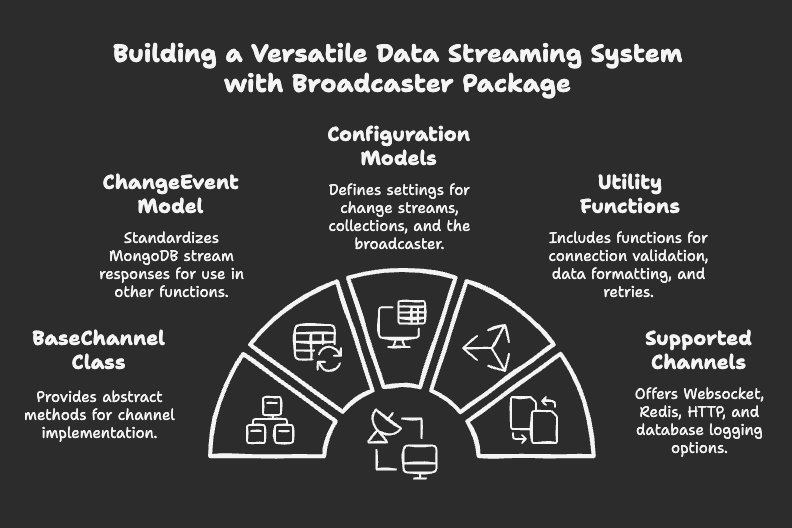
- 📡 Listen to MongoDB change streams
- 🚀 Built-in channels: WebSocket, Redis, HTTP, and Database Logging
- 🔌 Extensible architecture for custom channels
- ⚡ Async-first implementation
- 🛠️ Configurable pipelines and filtering
-
WebSocketChannel: Added a ping/pong monitor to detect dead clients (
PING_INTERVAL = 60s), plus configurabletimeoutanddisconnect_on_timeoutto automatically drop stale connections. The channel now supports anauthenticatecoroutine (return(bool, client_id)) to accept and assign client IDs, and replaces existing connections for the same client ID (closes old socket and cancels its ping task). Sending uses safe JSON serialization and includes robust disconnect handling on send failures. -
MongoChangeBroadcaster: Added a
custom_fnhook that can transformChangeEventobjects before delivery. Collection watchers now run with an exponential backoff retry (viatenacity) for resiliency, and the broadcaster validates the Mongo URI before connecting. You can filter by field-level changes withfields_to_watch, and extract recipients using dot-notation paths (e.g.owner.id) for targeted delivery. Start/stop flows and error logging were also improved.
pip install mongo-broadcaster

# Optional dependencies for specific channels:
pip install mongo_broadcaster[fastapi]  # WebSocket
pip install mongo_broadcaster[redis] # Redis Pub/Sub supportfrom mongo_broadcaster import (
MongoChangeBroadcaster,
BroadcasterConfig,
CollectionConfig
)
from mongo_broadcaster.channels import WebSocketChannel
# Initialize with MongoDB connection
config = BroadcasterConfig(
mongo_uri="mongodb://localhost:27017",
collections=[
CollectionConfig(
collection_name="users",
fields_to_watch=["name", "email"],
recipient_identifier="fullDocument._id"
)
]
)
broadcaster = MongoChangeBroadcaster(config)
broadcaster.add_channel(WebSocketChannel())
# Start listening (typically in your app startup)
await broadcaster.start()| Channel | Description | Ideal For |
|---|---|---|
WebSocketChannel |
Real-time browser updates | Live dashboards |
RedisPubSubChannel |
Pub/Sub messaging | Microservices |
HTTPCallbackChannel |
Webhook notifications | Third-party integrations |
DatabaseChannel |
Persistent change logging | Audit trails |
Implement your own channel by subclassing BaseChannel:
from mongo_broadcaster.channels.base import BaseChannel
from typing import Any, Dict


class CustomMQTTChannel(BaseChannel):
    def __init__(self, broker_url: str):
        self.broker_url = broker_url
        self.client = None

    async def connect(self):
	"""Initialize your connection"""
	self.client = await setup_mqtt_client(self.broker_url)

    async def send(self, recipient: str, message: Dict[str, Any]):
	"""Send to specific recipient"""
	await self.client.publish(f"changes/{recipient}", message)

    async def broadcast(self, message: Dict[str, Any]):
	"""Send to all subscribers"""
	await self.client.publish("changes/all", message)

    async def disconnect(self):
	"""Clean up resources"""
	await self.client.disconnect()

# Usage:
broadcaster.add_channel(CustomMQTTChannel("mqtt://localhost"))CollectionConfig(
collection_name: str,
database_name: Optional[str] = None,
# Fields to include in change events
fields_to_watch: List[str] = [],
# Dot-notation path to identify recipients (e.g., "fullDocument._id")
recipient_identifier: Optional[str] = None,
# MongoDB change stream options
change_stream_config: ChangeStreamConfig = ChangeStreamConfig()
)from fastapi import FastAPI, WebSocket
app = FastAPI()
ws_channel = WebSocketChannel()
@app.websocket("/ws/{client_id}")
async def websocket_endpoint(websocket: WebSocket, client_id: str):
await ws_channel.connect(client_id, websocket)
try:
while True:
await websocket.receive_text()
except WebSocketDisconnect:
await ws_channel.disconnect(client_id)Please see the examples folder for more.
To add new channels:
- Create a subclass of
BaseChannel - Implement required methods:
connect()send()broadcast()disconnect()
- Submit a PR!
MIT
- Write tests